
Mission
To build infrastructure that holds — banks that survive the flood season, roads that stay open through it, and structures that need less repair than they cost to build.
About the company
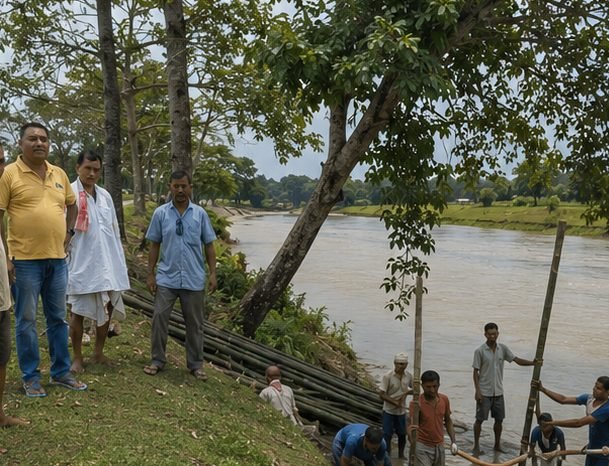
SkyShilp Construction India Private Limited works where the Brahmaputra and its tributaries keep redrawing the map — protecting banks, raising embankments and rebuilding the connections the water takes away.
01 Our story
SkyShilp Construction India Private Limited is a private limited company registered at Chaboti Bypass, North Lakhimpur, in the Lakhimpur district of Assam. We are a government-empanelled infrastructure and civil engineering contractor, and the majority of our work is carried out within a day’s reach of that office.
That is deliberate. Riverbank work is local knowledge as much as it is engineering: which reach scours first, where the borrow is clean, which approach road will still take a tipper in July. A contractor who lives on the same river as the site can answer those questions before mobilising rather than after.
The company takes on anti-erosion and flood protection schemes, rural roads and connectivity works, RCC and civil construction, and the earthwork that underpins all of them. We also provide construction supervision for works executed by others.
02 What guides the work
To build infrastructure that holds — banks that survive the flood season, roads that stay open through it, and structures that need less repair than they cost to build.
Engineering India’s future by building the backbone of rural Assam — a North-East where a settlement’s safety and its connection to the rest of the state are not seasonal questions.
03 Assam riverbank expertise
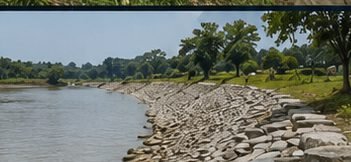
The Brahmaputra carries one of the heaviest sediment loads of any river in the world down a braided, shifting channel through soft alluvium. A bank does not fail politely: it is undercut at the toe and then collapses in blocks, sometimes taking tens of metres of land in a single season.
Protecting it means designing for launching — accepting that the bed will scour and building an apron that rolls down into the scour hole and armours it, rather than a wall that waits to be undermined.
05 Safety policy
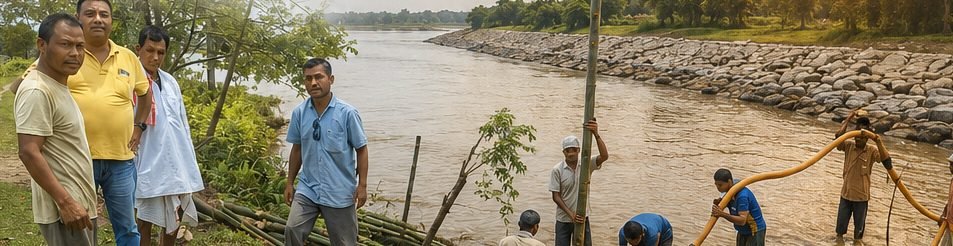
Our sites are in and beside moving water, often with plant working close to people. The policy below is the standing instruction to every supervisor on every SkyShilp site.
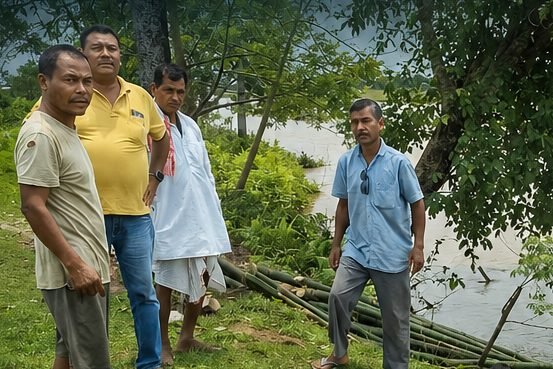
A toolbox talk is held at the start of every shift covering the day’s sequence, the hazards specific to that working face and the stop-work signal. Personal protective equipment is issued, checked and enforced. Plant is inspected before it is started.
Buoyancy aids are worn by anyone working in or over the channel. Crews work tethered where the current or the bed condition warrants it. Work stops when flow, visibility or bank stability changes — any worker may call that stop without needing permission.
Machines are operated only by trained operators. Exclusion zones are marked around slewing plant and no one works within the arc. Excavations are battered or supported according to soil, and edges are kept clear of spoil and traffic.
Sites next to villages are fenced or marshalled so that residents, children and livestock are kept away from the working face. Local labour is engaged wherever possible, inducted before starting, and paid at the agreed rate.
Incidents and near-misses are recorded and reviewed, and the method is changed where the review says it should be. Quality records — levels, cross-sections, material test results and stage photographs — are maintained alongside and handed over with the works.
We take on anti-erosion, flood protection, rural road and civil works across Assam and the wider North-East, as principal contractor or in support of another agency.